
A parsley seedling in early growth. At this stage, consistent moisture in the top centimetre of growing medium is essential for sustained development. Source: Wikimedia Commons (CC)
How Canadian Winter Heating Affects Indoor Humidity
When outdoor temperatures drop substantially below freezing — as they routinely do across most of Canada from November through March — the cold air outside holds very little moisture. When this air enters a home and is heated to typical indoor temperatures (20–22°C), its relative humidity drops considerably. In well-sealed modern homes, forced-air heating systems can drive indoor relative humidity to 20–30% or lower during severe cold snaps without active humidification.
For seedlings, the relevant effect is accelerated evaporation from the growing medium surface and from the foliage of emerged seedlings. A small cell containing 30–40 ml of growing medium can dry out within 12–18 hours in a heated room with low ambient humidity, particularly if the tray is near a heat vent. This makes watering frequency management more demanding than it would be in spring or summer.
Relative humidity in the range of 50–70% is generally considered appropriate for seedling production. Below 40%, evaporation rates increase noticeably and seedlings may show tip browning or slowed growth. A basic digital hygrometer placed near the growing area gives a useful reference reading.
Watering Techniques for Small Cells
Bottom Watering
Bottom watering — placing a tray insert into a reservoir of water and allowing the growing medium to absorb moisture upward through capillary action — is the standard technique for seedling cells. It avoids wetting the area immediately around the stem (a contributing factor to damping-off), distributes moisture more evenly through the cell volume, and reduces the risk of washing seeds or fine roots toward the surface.
To bottom water: fill the outer tray with 1–2 cm of water and leave the insert in it for 20–30 minutes, until the surface of the growing medium becomes visibly moist. Then remove the insert and allow any excess to drain. The outer tray should not hold standing water for more than an hour after watering — prolonged saturation at the roots promotes anaerobic conditions.
Misting for Germination
During the germination period — before seedlings have emerged — a fine mist sprayer can be used to moisten the surface of the growing medium without disturbing seeds or flooding cells. Misting does not penetrate deeply, so it should supplement, not replace, bottom watering once the medium at depth becomes dry. A mist sprayer is also useful for maintaining the inside surface of a humidity dome or cover, though excessive condensation inside a closed dome can indicate over-misting.
Watering Frequency
There is no single correct watering interval — it depends on cell size, growing medium composition, ambient temperature, humidity, and the light level. The most reliable approach is to check moisture daily and water based on the state of the growing medium rather than a fixed schedule.
A workable rule of thumb: allow the top 5 mm of growing medium to become dry before watering. In most Canadian winter indoor environments, this will translate to every 1–2 days for small cells (32–50 count inserts) and every 2–3 days for larger cells. Cells on a heat mat will dry faster.
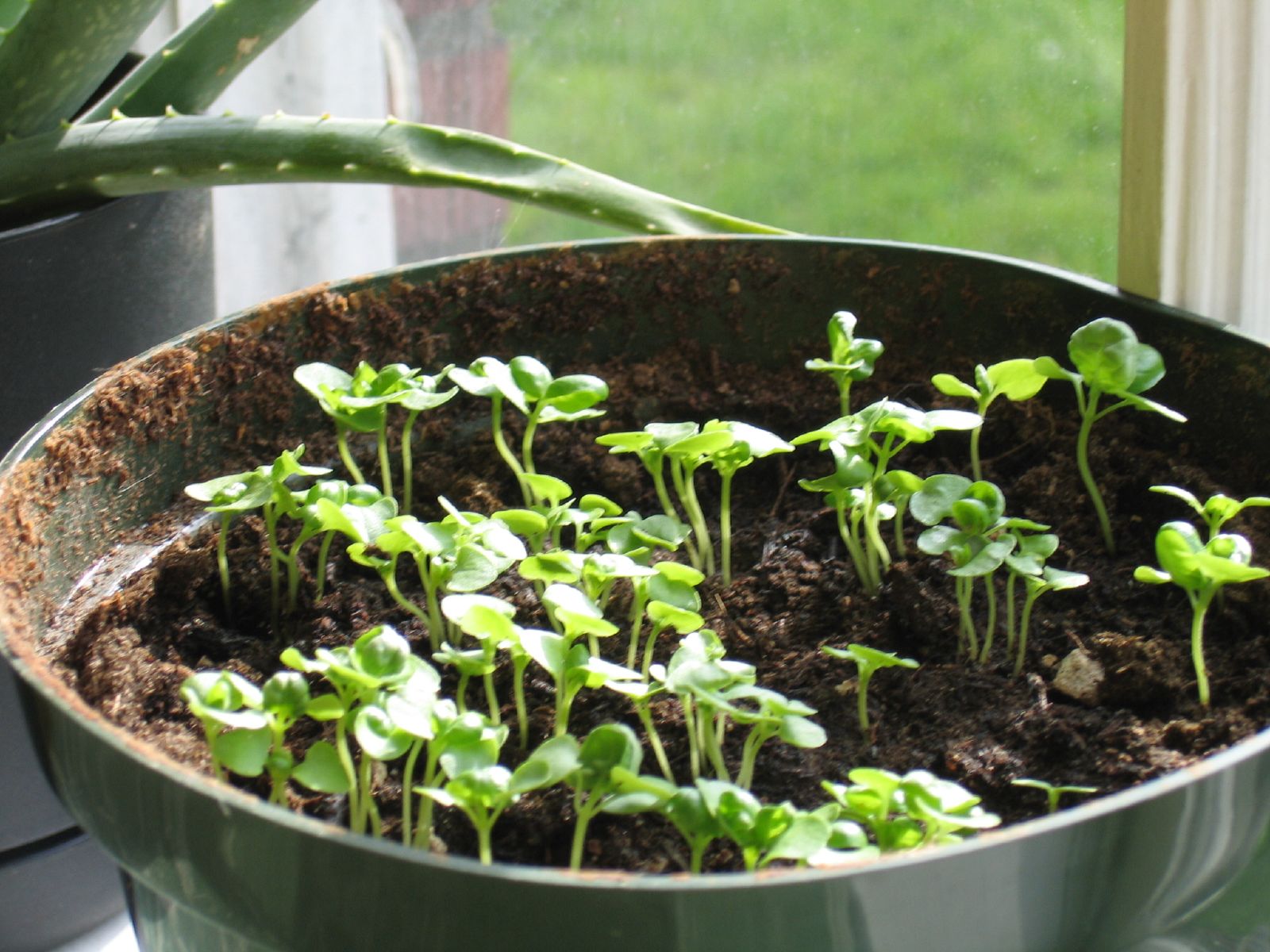
Basil sprouts in a pot. Basil is among the more sensitive herb seedlings to moisture variation — it shows signs of stress quickly when either overwatered or drought-stressed. Source: Wikimedia Commons (CC)
Increasing Ambient Humidity Near Seedlings
Several low-cost approaches can raise local humidity around a seedling tray without humidifying the entire room.
Humidity Dome or Cover
As discussed in the setup guide, a transparent cover over the tray creates a microenvironment with substantially higher humidity than the surrounding room air. This is the most effective and lowest-cost approach. The key limitation is that the cover must be removed or well-vented after seedlings emerge to prevent fungal issues; at that point, ambient room humidity becomes relevant again.
Tray of Pebbles and Water
Placing a shallow tray filled with pebbles and water near (not under) the seedling tray can raise local relative humidity by a few percentage points through evaporation. This effect is modest and depends on the water surface area relative to the room volume, but in a small, enclosed space (such as a window alcove partially curtained off) it can make a useful difference.
Small Room Humidifier
For a dedicated growing area — a spare room or enclosed porch — a small ultrasonic humidifier set to maintain 50–60% relative humidity provides reliable humidity control without manual management. This is more infrastructure than most windowsill setups require, but it is the most controllable option for serious early-season production.
Recognising Overwatering vs. Underwatering
Both problems appear as wilting, which makes visual diagnosis unreliable on its own. The distinction:
- Underwatered seedlings wilt when the growing medium is dry to the touch at depth and the cell feels light when lifted. The wilting typically occurs in the warmest or driest part of the day.
- Overwatered seedlings wilt despite the growing medium being saturated or near-saturated. The cell feels heavy. Roots in a chronically overwatered cell become oxygen-deprived and lose the ability to uptake water effectively even when surrounded by it. The growing medium may also develop a musty or sour smell.
Damping-off — the collapse of seedling stems at the soil line — is caused by fungal pathogens that thrive in persistently wet, low-airflow conditions. It is the most common fungal problem in windowsill seedling production. Good ventilation, appropriate watering practice, and avoiding overhead wetting of the stem area are the primary preventive measures. There is no effective recovery once a seedling has damped off; the cell should be removed and the growing medium not reused in the same tray without sterilisation.
Water Quality Considerations
In some Canadian cities, municipal water is treated with chlorine or chloramine. Chlorine dissipates readily if water is left to stand in an open container for several hours before use. Chloramine does not dissipate this way; for sensitive seedlings, filtered water or rainwater (collected outside) is an alternative. Most seedlings are not significantly affected by standard chlorinated municipal water at typical treatment levels, but salt-sensitive crops like basil or certain herbs may show marginal improvement with lower-TDS water.
Related Guides
This article covers one aspect of the indoor growing environment. The physical setup and lighting are covered in separate guides: