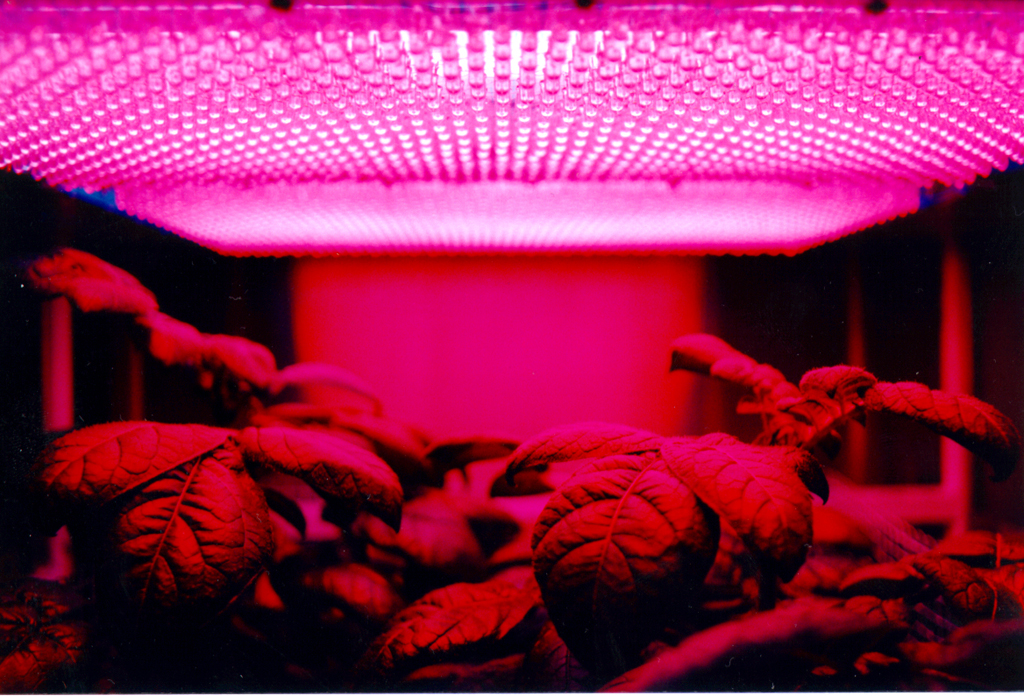
An LED panel positioned above indoor plants. Panel distance and daily photoperiod are the two primary variables to manage. Source: Wikimedia Commons (CC)
The Daylight Problem in Canadian Winters
Toronto averages under nine hours of daylight in December. Calgary and Edmonton see fewer than eight. Winnipeg and cities further north receive even less. Additionally, much of that daylight arrives at a low sun angle — light passing through a greater thickness of atmosphere and at a shallower angle to south-facing windows — which reduces the actual intensity reaching a windowsill considerably compared to summer levels.
Most warm-season vegetable seedlings (tomatoes, peppers, cucumbers, squash) require a daily light integral that is difficult to achieve with winter window light alone in most Canadian cities. Cool-season crops like lettuce, spinach, and some herbs are more tolerant, but even these benefit from supplemental lighting when started before March.
Daily Light Integral (DLI) is the total amount of photosynthetically active radiation a plant receives over a full day, measured in mol/m²/day. Tomato seedlings generally perform well at DLI values above 12–15 mol/m²/day. A south-facing window in Toronto in January typically provides 3–6 mol/m²/day on a clear day. Overcast periods reduce that further.
Types of Grow Lights Available in Canada
Full-Spectrum LED Panels
LED grow lights have become the standard choice for home seedling production over the past decade. They consume less power than older fluorescent or high-intensity discharge options, generate less heat (reducing the risk of burning seedlings when positioned close), and have a long operational lifespan. Full-spectrum LEDs designed for seedlings emit light across the photosynthetically active radiation range (approximately 400–700 nm), with some models including additional far-red wavelengths that can accelerate germination.
For a standard 1020 tray, a panel rated at 20–45 watts (LED draw, not equivalent) positioned 15–30 cm above the canopy is typically sufficient. Check the manufacturer's recommended coverage area — these vary substantially between consumer-grade and horticultural-grade products.
T5 Fluorescent Tubes
T5 fluorescent shop lights were the standard for seedling production before LED panels became widely available. They are still effective and more affordable to purchase initially, though they consume more power over a season and have a shorter lifespan. T5 bulbs labelled "6500K" (cool white / daylight spectrum) are appropriate for seedlings; warmer bulbs (3000–4000K) provide less of the blue-spectrum light that promotes compact seedling growth.
T5 fixtures need to be positioned closer to seedlings than LED panels — typically 5–10 cm — because their output drops off more quickly with distance.
LED Bar Lights
Narrow LED bars are designed to slot between shelf tiers in multi-level growing stands. They are a practical option when growing seedlings on a shelving unit placed away from a window, as the light comes from directly overhead. Their coverage per unit is narrower than a panel, so multiple bars are often needed to cover a full tray evenly.

A climate-controlled growth chamber at a research facility in Vancouver, BC, using LED lighting. Professional growing environments use the same LED technology available for home use, scaled differently. Source: Wikimedia Commons (CC)
Light Positioning and Distance
The relationship between fixture distance and light intensity follows an inverse square law: doubling the distance from the light source reduces intensity to approximately a quarter. This matters practically because seedlings positioned too far from a light source become etiolated (stretched, weak stems reaching toward the light), while those positioned too close can be heat-stressed or bleached by intensity.
A useful starting point: with an LED panel of moderate output (around 200–400 µmol/m²/s PPFD at the manufacturer's recommended distance), position it 20–25 cm above the seedling canopy. Raise the fixture as seedlings grow to maintain roughly that distance. Seedlings that are stretching toward the light or developing thin, pale stems are signalling that they need more light or closer proximity to the source.
Using a Timer
Most vegetable seedlings benefit from a consistent photoperiod. A 14–16 hour photoperiod (lights on) combined with an 8–10 hour dark period is a widely used approach for tomatoes, peppers, and similar crops. Continuous lighting (24 hours) can cause leaf chlorosis in some varieties and is generally not recommended. A simple plug-in mechanical or digital timer set once is sufficient — no manual switching needed.
Positioning Relative to the Window
When combining window light with a grow light, place the grow light directly above the tray so it supplements from overhead rather than from a side angle. Seedlings oriented toward a side light source will grow unevenly. If the grow light is the dominant source (as it should be in mid-winter), window proximity becomes secondary — though a south-facing location still contributes usefully on clear days.
Indicators of Light Deficiency
Several visual signs indicate insufficient light. Internode stretching — the stem sections between leaves become long and the plant leans — is the clearest indicator. Pale, yellow-green leaves in young seedlings can indicate either overwatering or insufficient light; if watering is appropriate, light is the more likely cause. Slow growth relative to the expected days-to-transplant schedule for the variety is also consistent with inadequate light levels.
Power and Cost Considerations
Running a 30-watt LED panel for 16 hours per day over 60 days (a typical seed-starting period in Canada) uses approximately 28.8 kWh. At typical Canadian electricity rates, which vary by province, this represents a modest cost. Quebec's rates are among the lowest in North America; Ontario, Alberta, and British Columbia rates are higher. Running lighting accounts for a real but not prohibitive portion of the overall cost of starting seedlings at home.
| Light Type | Typical Wattage (per 1020 tray) | Recommended Distance | Notes |
|---|---|---|---|
| Full-spectrum LED panel | 20–45 W | 15–30 cm | Low heat output, long lifespan |
| T5 fluorescent (4-tube) | 80–100 W | 5–10 cm | Lower upfront cost, higher running cost |
| LED bar lights (2–4 bars) | 20–60 W | 10–20 cm | Good for shelving setups |
Further Reading
The other guides on this site cover the physical enclosure setup and humidity management:
For background on plant light requirements, the Royal Horticultural Society's guidance on growing from seed under glass and research published through Agriculture and Agri-Food Canada provide reliable reference material.